.

Navigation Menu

Showing posts with label UNESCO. Show all posts

Berfend BER : The house of Virgin Mary


The house of Virgin Mary is located on the top of the "Bulbul" mountain 9 km of Ephesus. The house of Virgin Mary is a typical Roman architectural example, entirely made of stones. In the 4th century AD, a church, combining her house and grave, has been built. The original two-stored house, which consisted of an anteroom bedroom and praying room and a room with fireplace. A front kitchen fell into ruins and has been restored in 1940's. Today, only the central part and a room on the right of the altar are open to visitors. It is the place where Virgin Mary may have spent her last days.
VIRGIN MARY

Berfend BER : Ephesus Ancient City


Ephesus was an ancient Greek city, and later a major Roman city, on the west coast of Asia Minor, near the present-day town of Selçuk in Turkey’s Izmir Province. It was one of the twelve cities of the Ionian League during the Classical Greek era, and later, in the Roman period, it was the second largest city of the Roman Empire for many years, ranking only behind Rome, the empire's capital.

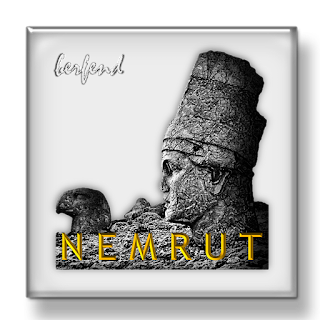
Berfend BER : Mount Nemrut & The God King of Commagene


" The mausoleum of Antiochus I (69–34 B.C.), who reigned over Commagene, a kingdom founded north of Syria and the Euphrates after the breakup of Alexander's empire, is one of the most ambitious constructions of the Hellenistic period. The syncretism of its pantheon, and the lineage of its kings, which can be traced back through two sets of legends, Greek and Persian, is evidence of the dual origin of this kingdom's culture. "( UNESCO World Heritage ) 

 Adıyaman is one of the richest places in Turkey in terms of cultural diversity.
" The best known tourist attraction in Adıyaman is Nemrut Mountain. While the mountain was the most valued by the city during the Kingdom of Commagene, it was very important for the city’s s well as Turkey’s tourism today. " MORE

Berfend BER : Mount Nemrut is one of the most interesting tourist attractions of Turkey.

Mount Nemrut
"The Hierotheseion of Antiochos I is one of the most ambitious constructions of the Hellenistic period. Its complex design and colossal scale combined to create a project unequalled in the ancient world. A highly developed technology was used to build the colossal statues and orthostats (stelae), the equal of which has not been found anywhere else for this period. The syncretism of its pantheon and the lineage of its kings, which can be traced back through two sets of legends, Greek and Persian, is evidence of the dual origin of this kingdom's culture. "( UNESCO World Heritage ) 
 NEMRUT DAG

 Adıyaman is one of the richest places in Turkey in terms of cultural diversity.
" The best known tourist attraction in Adıyaman is Nemrut Mountain. While the mountain was the most valued by the city during the Kingdom of Commagene, it was very important for the city’s s well as Turkey’s tourism today. " MORE

Berfend BER : Ruins of the Commagene Kingdom at Mount Nemrut

"Mount Nemrut retains its authenticity in terms of form, materials and design as one of the unique artistic achievements of the Hellenistic period with its fascinating beauty of monumental sculptures in a spectacular setting. It has survived in a moderately well-preserved state. The original ceremonial routes to the Hierotheseion are known and still used for access today.. "( UNESCO World Heritage ) 
Mount Nemrut

 Adıyaman is one of the richest places in Turkey in terms of cultural diversity.
" The best known tourist attraction in Adıyaman is Nemrut Mountain. While the mountain was the most valued by the city during the Kingdom of Commagene, it was very important for the city’s s well as Turkey’s tourism today. " MORE

Berfend BER : Mount Nemrut, Commagene Kingdom


" Crowning one of the highest peaks of the Eastern Taurus mountain range in south-east Turkey, Nemrut Dağ is the Hierotheseion (temple-tomb and house of the gods) built by the late Hellenistic King Antiochos I of Commagene (69-34 B.C.) as a monument to himself. " 
 Nemrut Dag

Nemrut Dağ is largely intact and truthfully and credibly expresses it Outstanding Universal Value. 

The Hierotheseion of Antiochos I is one of the most ambitious constructions of the Hellenistic period. Its complex design and colossal scale combined to create a project unequalled in the ancient world. A highly developed technology was used to build the colossal statues and orthostats (stelae), the equal of which has not been found anywhere else for this period. The syncretism of its pantheon and the lineage of its kings, which can be traced back through two sets of legends, Greek and Persian, is evidence of the dual origin of this kingdom's culture.

Nemrut Dağ retains its authenticity in terms of form, materials and design as one of the unique artistic achievements of the Hellenistic period with its fascinating beauty of monumental sculptures in a spectacular setting. It has survived in a moderately well-preserved state. The original ceremonial routes to the Hierotheseion are known and still used for access today... Continue reading 
 Adiyaman
Adıyaman is one of the richest places in Turkey in terms of cultural diversity.

" The best known tourist attraction in Adıyaman is Nemrut Mountain. While the mountain was the most valued by the city during the Kingdom of Commagene, it was very important for the city’s s well as Turkey’s tourism today. "... Centinue reading 


Berfend BER : Tourism in TURKEY & Tourism in Adıyaman


Adıyaman is one of the richest places in Turkey in terms of cultural diversity.


" The best known tourist attraction in Adıyaman is Nemrut Mountain. While the mountain was the most valued by the city during the Kingdom of Commagene, it was very important for the city’s s well as Turkey’s tourism today. "

The mausoleum of Antiochus I (69–34 B.C.), who reigned over Commagene, a kingdom founded north of Syria and the Euphrates after the breakup of Alexander's empire, is one of the most ambitious constructions of the Hellenistic period. The syncretism of its pantheon, and the lineage of its kings, which can be traced back through two sets of legends, Greek and Persian, is evidence of the dual origin of this kingdom's culture... Continue reading 
  
Within the scope of the promotional works made by Adıyaman Governor’s Office and the Culture and Tourism Ministry, a new documentary featuring the history of the city has been made and translated into many languages.

Another attraction in the city, the ancient city of Perre,The ancient city of Perre, or Pirin, located five kilometers from the city, is famous for its long history as well as the burial caves and cities built into the hills. 

HDNPerre was one of the largest cities of the Commagene Kingdom dating back to 162 B.C. Overall, 222 artifacts discovered during the 2001-2005 excavations were handed over to Adıyaman Museum. The excavations carried out since 2001 have uncovered historically important findings while promising further findings waiting to be unearthed as the work continues.

" Arsameia is notable for having one of the largest tablets of Anatolia. There are passages and the remains of a palace as well as Mithridathes Callinichos’ tomb and palace on the upper part of the area. "


Karakuş tumulus on the other hand has been built by Commagene King II. Mithridates. 

The Ulu Mosque has been restored several times; while Muattal shrine is a very powerful architecture for faith tourism. The city attracts tourism from all around with special emphasis on faith tourism. The churches in the city center such as St. Petrus and St. Pavlus date back to 1905 and have inscriptions telling stories from Christianity. The Syrian churches are also important attractions in the city..

Berfend BER ( Research Article ) Adiyaman Cuisine


" Almost all the foods in Adıyaman and made by hand and there are no zeytinyağlı (olive-oil) dishes. Several dishes take a considerable amount of time and effort to make. Some such dishes include stuffed köfte in a tart sauce, stuffed ribs, etc. "

There is a notable preponderance of dishes made with bulgur and sümüt (dried bread rounds). Just as in many other parts of Anatolia, foods based on wheat and wheat products dominate the cooking of Adıyaman as well...Continue reading 

Berfend BER : Metiokhos & Parthenope, Roman Mosaic from Zeugma

https://www.facebook.com/TT-Turizm-Tourism-1680380285509791/
It was found during the excavations carried out by the Museum of Gaziantep at Zeugma/Belkýs Kelekagzi region. 
A young man Originally from Phrygia. Metiokhos uras in love with a girl called Parthenope who had vowed to remain a virgin. She was in love with him too but she is also wanted to keep her vow.She cut her hair and became an exile. She went to Campania and devoted herself to the God of wine Dyonysos.(Napoli in Italy is named Parthenope in Greek because of this myth).But those who refused physical love was never forgiven by Aphrodite. For this reason she turned her in to the demon Siren with a woman’s head and a birds body.

 It is one of the Sirens. Her grave was said to be in Napoli. She jumped into the sea and suiaded with her sisters; the waves threw her corpse to the shore and a monument was built on Napoli shore in her name. In another version of the myth Parthenope was a young girl originally from Phrygia she fell in love with Metiokhos but she just couldn’t bring herself to take an action against her oath Parthenope punished herself and cut her hair and volunterily went to compania as an exile.She there devoted herself to Dyonysos and Aphrodit who got very angry with her turned Parthenope in to a demen called Siren with a birds body and woman’s head. 

The two figures of the mosaic which were smuggled out of Turkey 36 years ago from Zeugma by Euphrates part which will be burried under the Birecik Dam waters, is brought back to Gaziantep from the U.S.A. 

The two figures brought back from the USA on June 19 was assambled to the main port of the mosaic. The main port was found in Zeugma in 1993 and was brought to the Museum of Gaziantep. 


Berfend BER : Acratos and Euphrosyne, Roman Mosaic From Zeugma


It was found during the excavations carried out by the Museum of Gaziantep at Zeugma/Belkýs Kelekagzi region. 
Acratos and Euphrosyne ares shown seated at kline on Acratos is filling Euphrosyne’s cup out of a liquor jug shaped like a deer’s head. On the left the large liqour container crater takes place. Euphrosyne means joy and good spirits, she is one of the beauties called brightness sparkle and beauty and symbolises anything that is nice for sight. She is the daughter of Zeus and Eurynome. Acratos is a God that symbolises men who are weak against women

Berfend BER : Zeugma Mosaics Museum-Southeastern Turkey


T&T - Berfend BER " Oceanus, Roman Mosaic from Zeugma  "


Oceanos, the archaic era lives with Tethys who symbolizes the feminine component in the sea. It is believed that all rivers and stream came into existence from Oceanus and Tethys. Gaziantep Mosaic Museum - Gaziantep, Turkey.


 " Gaziantep Zeugma Mosaic Museum "

Zeugma Mosaic Museum, in the town of Gaziantep, Turkey, is the biggest mosaic museum in the world, containing 1700m2 of mosaics. It opened to the public on 9 September.

T&T - SK.Berfend BER " Tourism in TURKEY & Tourism in Gaziantep" Berfend BER – Gaziantep Zeugma Mosaic Museum ( https://lnkd.in/dgG7tkx )

Turizm & Tourism LINKEDIN GROUP (https://lnkd.in/dXUDj4P ) 
Turizm & Tourism TWITTER ( https://lnkd.in/d2PKsK4 )

Stunning beaches, ancient attractions, and a perfect blend of lively and peaceful.

Follow @berfendber