



Showing posts with label CULTURAL HERITAGE. Show all posts


TRAVEL in TURKEY & TRADITIONAL TURKISH CUISINE

Traditional Turkish Cuisine
Turkish cuisine is seen as of the three richest and oldest cooking traditions of the world together with French and Chinese cooking.
While it has come to be associated with kebap, baklava, lokum and rakı there is a rich and variegated tradition of soups, olive oil dishes, rice pilafs, stuffed vegetables, pastries, puddings and syrupy desserts underlying these popular dishes. It offers unique tastes in spicy and tart appetizers, pickles, fruit preserves, compote, sherbet, boza (a thick beverage made of barley) and coffee.
The diversity of Turkish cuisine reflects the cultures of the populations living in regions highly dissimilar in geography and climate. This has led to an abundance of ingredients and cooking styles. The Southeast and the East are known for the dishes based on cracked wheat and meat with hot spices, the Aegean, for olive oil dishes enhanced with local herbs, the Black Sea region, for varieties of anchovy and collard, and Istanbul is a world unto itself with, among others, eggplant dishes which come in no less then 41 sorts.
The latest trend in İstanbul restaurants is the fast food version of the traditional simit (kind of bagel) and börek (pastry)
.
.
Stuffed vegetables and wraps
They constitute a unique aspect of Turkish cuisine. The classical wrap is meat or rice wrapped in vine, cabbage or collard leaves although lettuce, nut, chestnut, cherry and even violet leaves are sometimes used. There are about 15 varieties of vegetables stuffed with meat today.


Stuffed Eggplant and Peppers Stuffed Vine Leaves in Olive Oil
Meat dishes
There is a rich variety including gyros type dishes, grills, fried meats, kebaps, stews, meat cooked in a crock or pan. There are also boiled meats, meat balls, vegetables stuffed with meat and meat dishes cooked with fruits.
Olive oil dishes
They are an integral part of lunch and dinner especially in the summer. They can be served warm or cold. Olive (or vegetable) oil can be used to fry eggplants, peppers and zucchini or cook them in an onion and tomato sauce and letting them simmer.


Fava ( The mashed broad beans ) Red Pepper Roast
Ramadan tables
The food is less heavy than it once was but still consists of a long menu including soup, a meat dish, choice of pastry, pilaf or pasta, olive oil dish, salad and dessert. The tradition of inviting friends and relatives to elaborate dinners to break the fast continues. Food is accompanied by the pides which can be bought hot at the neighborhood bakery on Ramadan afternoons.
Istanbul cuisine
It is the cuisine of an imperial city featuring a wide variety of ingredients and cooking styles. It includes dishes and ideas from the cuisine of Jews, Greeks and Armenians who were an integral part of Ottoman society.

Modern-day Turkish cuisine is mostly the heritage of Ottoman cuisine, which some might correctly describe as being a fusion and refinement of culinary traditions from neighboring countries, as well as the Middle East, Central Asian and Western European influences. This of course stems from the many centuries in which the Ottoman Empire waged war with many of the European peoples in Central and Eastern Europe.


Having had to deal with a wide mix of cultures and peoples it only makes sense for Turkish cuisine to show an incredible amount of variety on the same theme. Let’s take the Black Sea region for instance, where there are over twenty different dishes that incorporate corn as well as a plethora of ways of preparing hamsi – a sardine-like. The interesting thing being that of course, you will find dishes similar to these in the surrounding countries of Bulgaria, Romania and so on.
Kebabs
 |
| Ottoman Cuisine & Istanbul Cuisine |
Possibly one of the most international ubiquitous Turkish dish is the kebab. These are a great example of both variety and simplicity in action. They are made from either plain or marinated meat which is then either stewed or grilled – most commonly grilled in the West. In Turkey, each district in the country has its own special recipe.
The ‘Sis kebab’, which is famous the world-around is made from pieces of lamb threaded on a skewer and griller over charcoal, then there’s the ‘Doner kebab’ which is made from a roll of lamb on a vertical skewer turning parallel to a hot grill, and these are just two of the most popular versions.
Turkish sweets
The results of the Turks’ sweet-tooth are famous throughout the world. Many of the sweets in Turkey are milk based but possibly the best well known are the pastries, respectively ‘baklava’ and ‘kadayif’.
Then of course there’s Turkish delight or Lokum, which is a unique type of confection made on a gel of starch and sugar. Some varieties will include pieces of nuts and fruit bound in the gel. The confections are packaged in small cubes which are usually dusted with icing sugar in order to prevent them from sticking to each other.


Lokum ve Akide Şekeri Katmer
Turkish beverages
Turkish coffee is chief amongst the national drinks, being of such important to the daily life of the Ottoman Empire that it introduced coffee and the idea of a coffee house to all the countries that they warred with. Turkish coffee is thick and dark and is served in a small cup. The process of making the coffee is a particular one as well, one which we’ll not detail here.


Turkish Tea Turkish Coffee
Obviously we’ve only skimmed the surface of the massive and intricate labyrinth that Turkish cuisine is, visiting Turkey will surely result in you discovering many other interesting foods and drinks.
 |
| Turkish Cuisine & Ottoman Cuisine - Photos |
Berfend BER : Mount Nemrut & The God King of Commagene

" The mausoleum of Antiochus I (69–34 B.C.), who reigned over Commagene, a kingdom founded north of Syria and the Euphrates after the breakup of Alexander's empire, is one of the most ambitious constructions of the Hellenistic period. The syncretism of its pantheon, and the lineage of its kings, which can be traced back through two sets of legends, Greek and Persian, is evidence of the dual origin of this kingdom's culture. "( UNESCO World Heritage )

" The best known tourist attraction in Adıyaman is Nemrut Mountain. While the mountain was the most valued by the city during the Kingdom of Commagene, it was very important for the city’s s well as Turkey’s tourism today. " MORE
Berfend BER : Mount Nemrut is one of the most interesting tourist attractions of Turkey.

"The Hierotheseion of Antiochos I is one of the most ambitious constructions of the Hellenistic period. Its complex design and colossal scale combined to create a project unequalled in the ancient world. A highly developed technology was used to build the colossal statues and orthostats (stelae), the equal of which has not been found anywhere else for this period. The syncretism of its pantheon and the lineage of its kings, which can be traced back through two sets of legends, Greek and Persian, is evidence of the dual origin of this kingdom's culture. "( UNESCO World Heritage )
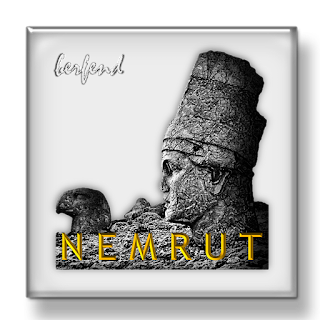
" The best known tourist attraction in Adıyaman is Nemrut Mountain. While the mountain was the most valued by the city during the Kingdom of Commagene, it was very important for the city’s s well as Turkey’s tourism today. " MORE
Berfend BER : Ruins of the Commagene Kingdom at Mount Nemrut

"Mount Nemrut retains its authenticity in terms of form, materials and design as one of the unique artistic achievements of the Hellenistic period with its fascinating beauty of monumental sculptures in a spectacular setting. It has survived in a moderately well-preserved state. The original ceremonial routes to the Hierotheseion are known and still used for access today.. "( UNESCO World Heritage )

Adıyaman is one of the richest places in Turkey in terms of cultural diversity.
" The best known tourist attraction in Adıyaman is Nemrut Mountain. While the mountain was the most valued by the city during the Kingdom of Commagene, it was very important for the city’s s well as Turkey’s tourism today. " MORE
Berfend BER : Uluslararası Turizmde Türkiye Turizmi Olmadan, Olmaz

T&T- Berfend BER " International tourism in the world,Will not be without Turkey tourism "
T&T "About Turkey" - International tourism in the world,Will not be without Turkey tourism (https://lnkd.in/d8mgQby )
Berfend BER : Metiokhos & Parthenope, Roman Mosaic from Zeugma
 |
| https://www.facebook.com/TT-Turizm-Tourism-1680380285509791/ |
It was found during the excavations carried out by the Museum of Gaziantep at Zeugma/Belkýs Kelekagzi region.
A young man Originally from Phrygia. Metiokhos uras in love with a girl called Parthenope who had vowed to remain a virgin. She was in love with him too but she is also wanted to keep her vow.She cut her hair and became an exile. She went to Campania and devoted herself to the God of wine Dyonysos.(Napoli in Italy is named Parthenope in Greek because of this myth).But those who refused physical love was never forgiven by Aphrodite. For this reason she turned her in to the demon Siren with a woman’s head and a birds body.
It is one of the Sirens. Her grave was said to be in Napoli. She jumped into the sea and suiaded with her sisters; the waves threw her corpse to the shore and a monument was built on Napoli shore in her name. In another version of the myth Parthenope was a young girl originally from Phrygia she fell in love with Metiokhos but she just couldn’t bring herself to take an action against her oath Parthenope punished herself and cut her hair and volunterily went to compania as an exile.She there devoted herself to Dyonysos and Aphrodit who got very angry with her turned Parthenope in to a demen called Siren with a birds body and woman’s head.
The two figures of the mosaic which were smuggled out of Turkey 36 years ago from Zeugma by Euphrates part which will be burried under the Birecik Dam waters, is brought back to Gaziantep from the U.S.A.
The two figures brought back from the USA on June 19 was assambled to the main port of the mosaic. The main port was found in Zeugma in 1993 and was brought to the Museum of Gaziantep.

It is one of the Sirens. Her grave was said to be in Napoli. She jumped into the sea and suiaded with her sisters; the waves threw her corpse to the shore and a monument was built on Napoli shore in her name. In another version of the myth Parthenope was a young girl originally from Phrygia she fell in love with Metiokhos but she just couldn’t bring herself to take an action against her oath Parthenope punished herself and cut her hair and volunterily went to compania as an exile.She there devoted herself to Dyonysos and Aphrodit who got very angry with her turned Parthenope in to a demen called Siren with a birds body and woman’s head.
The two figures of the mosaic which were smuggled out of Turkey 36 years ago from Zeugma by Euphrates part which will be burried under the Birecik Dam waters, is brought back to Gaziantep from the U.S.A.
The two figures brought back from the USA on June 19 was assambled to the main port of the mosaic. The main port was found in Zeugma in 1993 and was brought to the Museum of Gaziantep.
Berfend BER : Acratos and Euphrosyne, Roman Mosaic From Zeugma

It was found during the excavations carried out by the Museum of Gaziantep at Zeugma/Belkýs Kelekagzi region.
Acratos and Euphrosyne ares shown seated at kline on Acratos is filling Euphrosyne’s cup out of a liquor jug shaped like a deer’s head. On the left the large liqour container crater takes place. Euphrosyne means joy and good spirits, she is one of the beauties called brightness sparkle and beauty and symbolises anything that is nice for sight. She is the daughter of Zeus and Eurynome. Acratos is a God that symbolises men who are weak against women
ATATÜRK - This nation has never lived without freedom, cannot and never will.

T&T Berfend BER " ABOUT TURKEY "
The Anatolian peninsula, comprising most of modern Turkey, is one of the oldest permanently settled regions in the world.
" The Turkish Nation consists of the valiant descendants of a people that has lived independently and has considered independence the sole condition of existence. This nation has never lived without freedom, cannot and never will. " ATATÜRK
T&T " ABOUT TURKEY "( https://lnkd.in/dH9aZ_C )
Turizm & Tourism TWITTER https://lnkd.in/d2PKsK4
Berfend BER : Zeugma Mosaics Museum-Southeastern Turkey

T&T - Berfend BER " Oceanus, Roman Mosaic from Zeugma "
Oceanos, the archaic era lives with Tethys who symbolizes the feminine component in the sea. It is believed that all rivers and stream came into existence from Oceanus and Tethys. Gaziantep Mosaic Museum - Gaziantep, Turkey.
" Gaziantep Zeugma Mosaic Museum "
Zeugma Mosaic Museum, in the town of Gaziantep, Turkey, is the biggest mosaic museum in the world, containing 1700m2 of mosaics. It opened to the public on 9 September.
T&T - SK.Berfend BER " Tourism in TURKEY & Tourism in Gaziantep" Berfend BER – Gaziantep Zeugma Mosaic Museum ( https://lnkd.in/dgG7tkx )
Subscribe to:
Posts
(
Atom
)


